
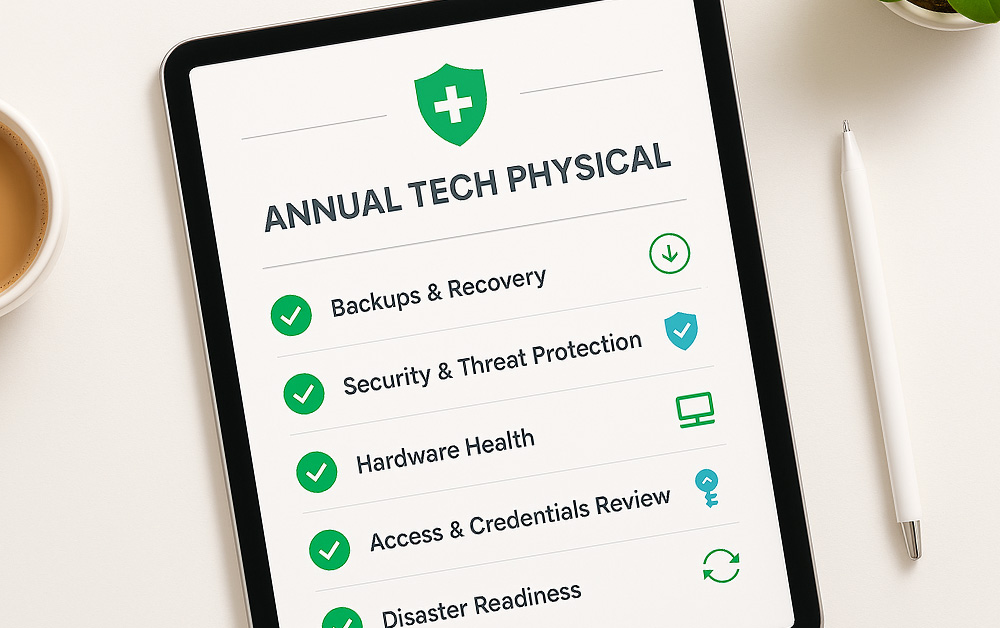
Your Business Tech Is Overdue for an Annual Physical
January is the month people finally schedule the things they’ve been putting off. The doctor, the dentist, maybe even that weird noise in the car.
Somewhere right now, a cybercriminal is setting New Year’s resolutions. They’re not thinking about self-care or work-life balance. They’re reviewing what worked in 2025 and planning how to steal more in 2026. And small businesses are their favorite target. Not because you’re careless, but because you’re busy and criminals love busy.
Here’s the good news. Once you understand their 2026 game plan, it becomes a lot easier to shut it down. Let’s walk through what they’re planning and how to ruin it.
The era of laughably bad scam emails is over.
AI now writes messages that:
They don’t need typos to get you. They need timing.
And January is perfect timing. Everyone’s distracted, moving fast, catching up from the holidays.
Here’s what a modern phishing email looks like:
“Hi [your actual name], I tried to send the updated invoice, but the file bounced back. Can you confirm this is still the right email for accounting? Here’s the new version — let me know if you have questions. Thanks, [name of your actual vendor]”
No Nigerian prince. No urgent wire transfer. Just a normal-sounding request from someone you recognize.
This one is brutal because it feels so real.
A vendor email arrives:
“Hey, we updated our bank details. Please use this new account for future payments.”
Or a text from “the CEO” hits your bookkeeper:
“Urgent. Wire this now. I’m in a meeting and can’t talk.”
Sometimes it’s not even text anymore.
Deepfake voice scams are rising. They clone voices from YouTube videos, podcast appearances, even voicemail greetings. The “CEO” calls your finance person and asks for a “quick favor,” and it sounds exactly like them.
That’s not sci-fi. That’s Tuesday.
For years, cybercriminals focused on big targets. Banks. Hospitals. Fortune 500 companies.
But enterprise security got better. Insurance requirements got tighter. Big companies became hard and annoying to attack.
So the smart criminals pivoted.
Instead of one $5 million attack that’s difficult and risky, why not a hundred $50,000 attacks that are almost guaranteed to work?
Small businesses are now the primary target. You have money worth stealing. You have data worth ransoming. And you probably don’t have a dedicated security team.
Attackers know:
That belief is their favorite vulnerability.
January brings new hires. And new hires don’t know your rules yet.
They’re eager to impress. They want to be helpful. They’re unlikely to question authority.
From an attacker’s perspective? Perfect targets.
“Hey, I’m the CEO. Can you handle this quickly? I’m traveling and can’t do it myself.”
A veteran employee might think twice. A new hire who wants to make a good impression? They’re already on it.
Tax season scams ramp up soon too. W-2 requests. Payroll phishing. Fake IRS notices.
The attack is simple: Someone impersonates your CEO or HR director and sends an “urgent” request to whoever handles payroll. “I need copies of all employee W-2s for a meeting with the accountant. Send ASAP.”
Once they have those W-2s, every employee’s Social Security number, address and salary is compromised. The criminals file fraudulent tax returns before your employees file theirs. Your people find out when their legitimate returns get rejected as “duplicates.”
You have two choices with cybersecurity:
Option A: React after the attack. Pay the ransom, hire emergency help, notify customers, rebuild systems, repair your reputation. Cost: tens or hundreds of thousands of dollars. Timeline: weeks to months. Outcome: You might survive, but you’ll never forget it.
Option B: Prevent the attack. Implement proper security. Train your team. Monitor for threats. Close vulnerabilities before they’re exploited. Cost: a fraction of Option A. Timeline: ongoing, in the background. Outcome: Nothing happens — which is the whole point.
You don’t buy a fire extinguisher after the building burns.
You buy it because you’d never need it.
A good IT partner keeps you off the “easy target” list by:
Fire prevention, not firefighting.
Criminals are setting their 2026 goals right now. They’re optimistic about the year ahead. They’re counting on businesses like yours to be unprepared, understaffed and unprotected.
Let’s disappoint them and tke your business off their target list.
We’ll show you where you’re exposed, what matters most and how to stop being low-hanging fruit in 2026. No scare tactics. No jargon. Just a clear picture of where you stand and what to do about it.
Book your 15-minute New Year Security Reality Check here. Because the best New Year’s resolution is making sure you’re not on someone else’s list of goals to achieve.
Complete this form to get started and we will contact you to discuss the next steps. Or call us at 1-833-231-6182 to get started.
January is the month people finally schedule the things they’ve been putting off. The doctor, the dentist, maybe even that weird noise in the car.
Millions of people are doing Dry January right now. They’re cutting the one thing they know isn’t helping, because they want to feel better, work

January is a magical month. For a few weeks, everyone believes they’re a new person. Gyms are full, planners are open, and good intentions are