When Everything Feels Like a Priority, How Does Your Practice Build an IT Budget?
If the roof is leaking and the waiting room is showing its age, both may need work. But only one of them is going to

Every autumn, the medicine cabinet gets a little more crowded. There is cold medicine left over from last winter, vitamins bought in bulk, half-used bottles of cough syrup and a prescription that should have been thrown out months ago. There is plenty of medicine there, but a full cabinet has never been a measure of anyone’s health.
Your practice can reach a similar position with cybersecurity. A new threat prompts one purchase, an insurance requirement leads to another and a vendor recommendation adds something else. Over time, the more useful question becomes whether your practice has the right protection in place and whether your team is doing what it needs to do, especially with patient records on the line.
A longer list of security products can look like stronger protection, but the two are not necessarily the same thing.
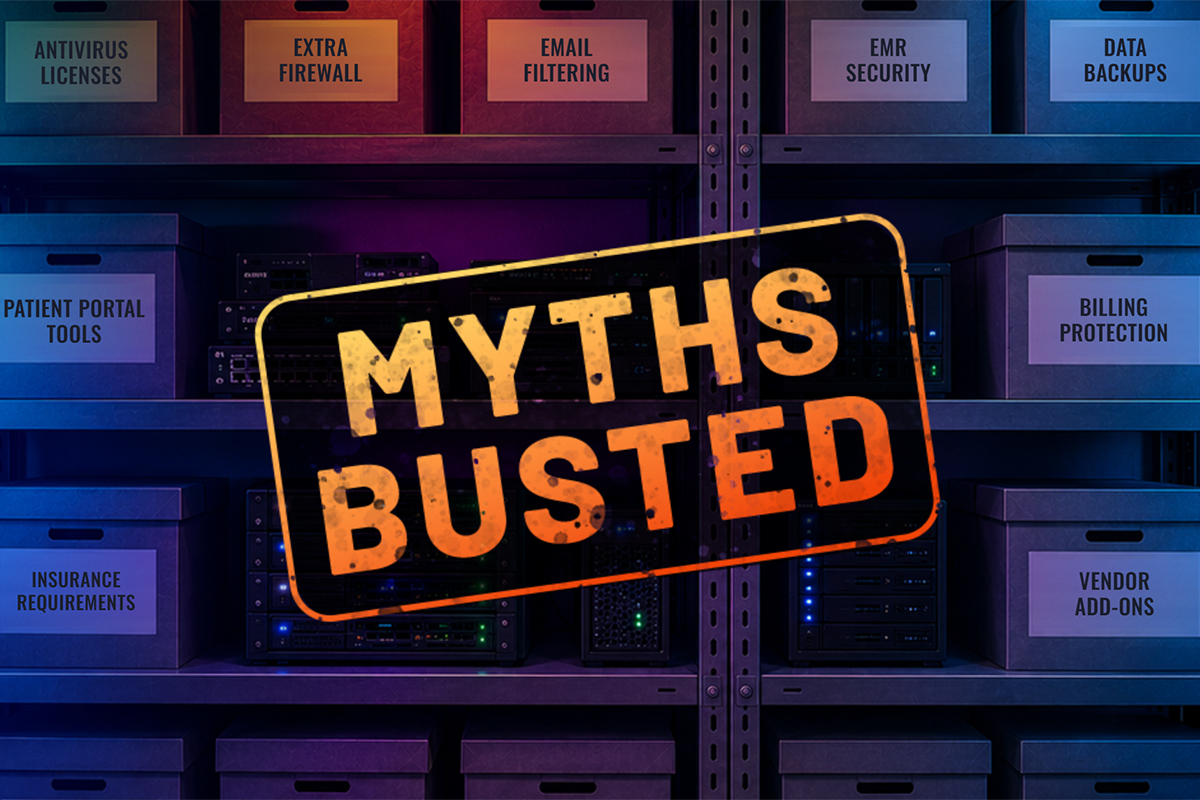
It is an easy assumption to make. If one security product adds protection, then adding more should make your practice even safer. But that is where the myth starts to break down.
Multiple layers of protection can be valuable, but only when each one serves a clear purpose. Adding another product may address a specific concern, whether it is your EMR, your patient portal or your billing system, but it can also create unnecessary overlap or additional complexity if no one considers how everything fits together.
What matters is whether the right safeguards are in place, properly managed and working together to address the risks your practice actually faces. Strong cybersecurity depends on having a coordinated approach rather than simply piecing together tools over time.
Your own immune system is not a shelf of individual remedies. It is a coordinated system designed to recognize problems and respond to them. Your practice’s cybersecurity should work the same way, but for many practices, the pieces do not always come together that neatly.
Tools get purchased to solve specific problems. Staff receive policies and training. New safeguards are added as risks change or requirements evolve. Each decision may make sense on its own, but over time, those individual pieces can become disconnected from the bigger picture, and from the systems that hold patient information.
That is where coordination matters. The right safeguards should complement each other rather than simply coexist. Staff should understand what is expected of them, and there should be a clear process for responding when suspicious activity occurs, particularly anything touching patient records.
Security tools are part of that system, but they are most effective when they work as part of a broader approach that still fits how your practice actually operates.
You do not need to understand the technical details of every cybersecurity product your practice uses, but you should be able to get clear answers to a few basic questions.
Most healthcare practices we talk to are under-protected because nobody has stepped back to look at the full picture. That can be difficult to do from the inside. We help practices like yours make sense of what is already in place, identify unnecessary overlap and uncover gaps that may have developed over time. From there, we can help determine whether the protections you have still align with how your practice operates and the patient data you are responsible for protecting.
A full toolbox is not the same as a coordinated defense, and the difference matters most when patient data is involved. Schedule a Free Discovery Call and let’s take a closer look together.
Or call us at 1-833-231-6182.

If the roof is leaking and the waiting room is showing its age, both may need work. But only one of them is going to

It is easy to feel confident about your IT budget in January. Everything is organized and approved, and you have a clear picture of what

If you look at any suburb this Halloween, you will see countless monsters roaming the streets. Vampires, creatures and ghouls all “wreaking havoc,” going to